Israel’s Establishment in 1948: the Original UN Cablegram
On 15 May 1948, the United Nations Security Council received a cablegram from Moshe Shertok, Foreign Secretary of the Provisional Government of Israel, announcing the establishment of the State of Israel and requesting admission to the United Nations.
The historical document, catalogued as UN Security Council document S/747, records the provisional government's position and reproduces key passages from the proclamation issued on 14 May 1948.
What did the cablegram say?
The document refers to the UN General Assembly's Resolution 181, adopted on 29 November 1947, which recommended the partition of Mandatory Palestine into separate Arab and Jewish states, with a special international regime proposed for Jerusalem.
The proclamation quoted in the cablegram declared the establishment of a Jewish state in Palestine under the name Israel. It also set out commitments concerning immigration, civil and political equality, religious freedom, the protection of holy places, and cooperation with the United Nations.
The cablegram concluded with a formal request for Israel's admission to UN membership.
What does this historical document establish?
The cablegram is primary-source evidence of how the Provisional Government of Israel formally communicated the establishment of the new state and presented its legal and political claims to the United Nations in May 1948.
It is important, however, to distinguish the document's statements from independently established historical facts. Its assertions about historical rights, the legal effect of the 1947 UN resolution, and the establishment of sovereignty represent the position expressed by the provisional government. The cablegram alone does not resolve every legal or historical question surrounding the creation of Israel, the status of Palestine, or the consequences of the 1948 war.
Reading the original document allows us to examine the language, commitments, and diplomatic strategy of the provisional government at a pivotal moment in modern Middle Eastern history.
The Significance of UN Document S/747
Document S/747 is notable not just for what it announces, but for how it positions the newly declared state on the international stage.
By grounding its claims in UN Resolution 181, the Provisional Government sought to legitimize its declaration of independence within the framework of international law and the UN’s own recommendations. Furthermore, by explicitly emphasizing commitments to equality, religious freedom, and the safeguarding of holy sites, the cablegram served as an opening diplomatic maneuver aimed at reassuring the international community and securing rapid recognition.
Ultimately, Israel was admitted as the 59th member of the United Nations a year later, on 11 May 1949, under UN General Assembly Resolution 273.
Frequently Asked Questions (FAQ)
1. Who was Moshe Shertok?
Moshe Shertok (who later changed his surname to Sharett) was the Foreign Secretary of the Provisional Government of Israel in 1948. He became the nation's first Minister of Foreign Affairs and later served as the second Prime Minister of Israel from 1954 to 1955.
2. What was UN General Assembly Resolution 181?
Passed on 29 November 1947, Resolution 181 proposed the partition of the British Mandate for Palestine into independent Arab and Jewish states, with a Special International Regime (Corpus Separatum) for the city of Jerusalem. The resolution was accepted by the Jewish leadership but rejected by Arab leadership.
3. Was Israel immediately admitted to the United Nations after this cablegram?
No. The cablegram sent on 15 May 1948 was Israel's initial request for admission. However, the UN Security Council did not immediately approve the application, citing the ongoing 1948 Arab-Israeli War and debates over borders and refugees. Israel was formally admitted to the UN a year later, on 11 May 1949.
4. Why is Document S/747 important to historians?
It is a primary source that documents the exact diplomatic and legal arguments the founders of Israel presented to the international community hours after declaring independence. It shows how the provisional government navigated international law, particularly by referencing Resolution 181, to justify its statehood.
---
Authoritative Sources
1. United Nations Security Council Document S/747: Cablegram dated 15 May 1948 from the Foreign Secretary of the Provisional Government of the State of Israel addressed to the Secretary-General. [View in the UN Digital Library]
2. United Nations General Assembly Resolution 181 (II): Future government of Palestine, adopted 29 November 1947. [View in the UN Digital Library]
3. United Nations General Assembly Resolution 273 (III): Admission of Israel to membership in the United Nations, adopted 11 May 1949. [View in the UN Digital Library]
Read the historical record and consider what it says directly, what it claims, and what other sources are needed to understand the wider context.
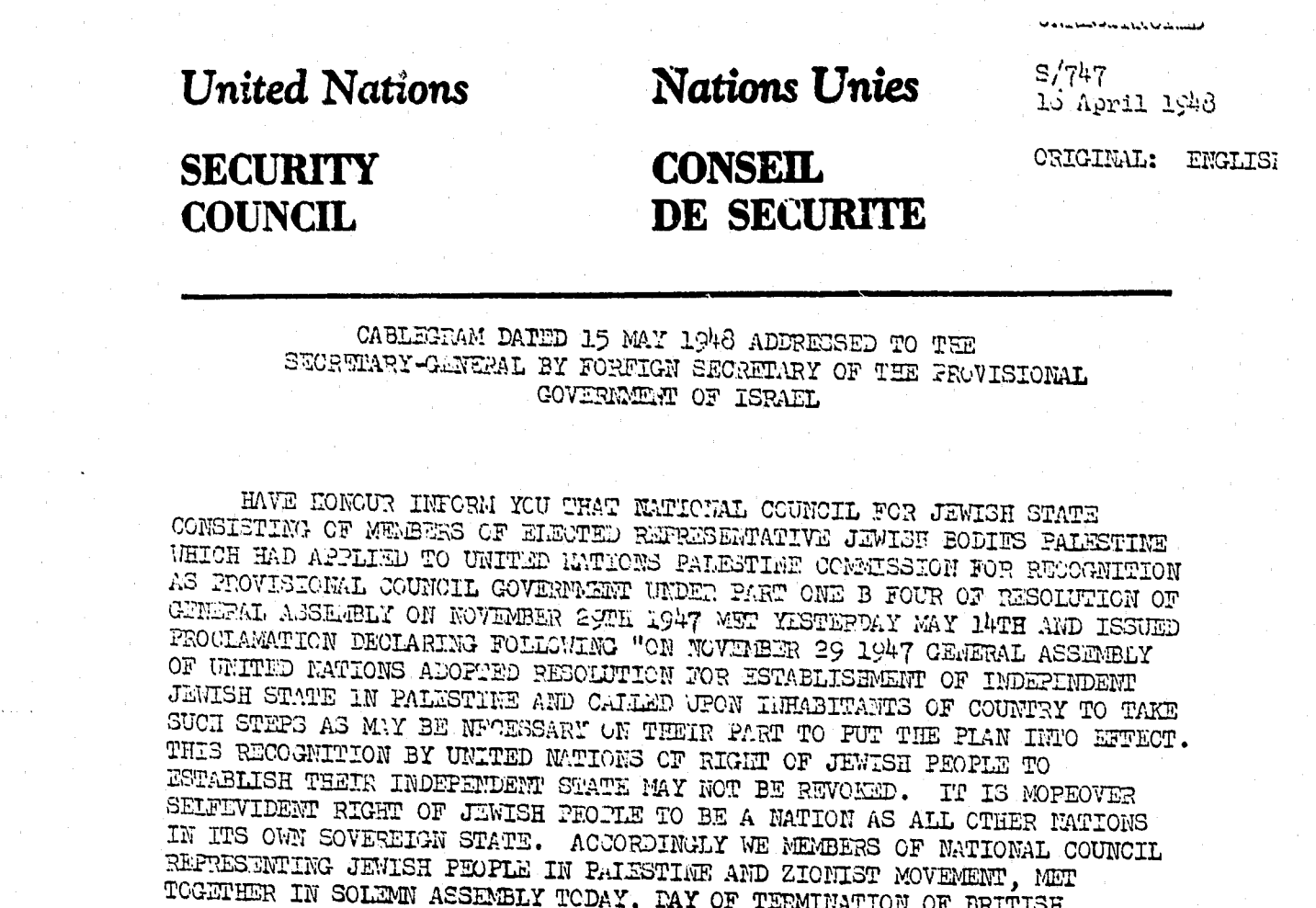
Cablegram dated 15 May 1948 addressed to the Secretary-General by Foreign Secretary of the Provisional Government of Israel
Have honour inform you that National Council for Jewish State consisting of members of elected representative Jewish bodies Palestine which had applied to United Nations Palestine Commission for recognition as provisional council government under Part One B Four of resolution of General Assembly on November 29th 1947 met yesterday May 14th and issued proclamation declaring following:
“On November 29 1947 General Assembly of United Nations adopted resolution for establishment of independent Jewish State in Palestine and called upon inhabitants of country to take such steps as may be necessary on their part to put the plan into effect. This recognition by United Nations of right of Jewish people to establish their independent State may not be revoked. It is moreover self-evident right of Jewish people to be a nation as all other nations in its own sovereign State. Accordingly we members of National Council representing Jewish people in Palestine and Zionist Movement, met together in solemn assembly today, day of termination of British Mandate for Palestine, by virtue of natural and historic right of Jewish people and of resolution of General Assembly hereby proclaim establishment of Jewish State in Palestine to be called Israel.
We hereby declare that as from termination of Mandate this night of 14th to 15th May 1948 and until setting up of duly elected bodies of State in accordance with constitution to be drawn up by Constituent Assembly not later than 1st October 1948 present National Council shall act as provisional State Council and its Executive Organ shall constitute provisional Government of State of Israel.
State of Israel will be open to immigration of Jews from all countries of dispersion, will promote development of country for benefit of all inhabitants, will be based on precepts of liberty, justice and peace, will uphold full social and political equality of all citizens without distinction race, creed or sex, will guarantee full freedom of conscience, worship, education, culture and language, will safeguard sanctity and inviolability of shrines and holy places of all religions and will dedicate itself to principles of United Nations Charter.
State of Israel will be ready cooperate with organs and representatives of United Nations in implementation of resolution of Assembly of November 29 1947 and will take steps to bring about economic union over whole of Palestine.
We appeal to United Nations to assist Jewish people in building of its State and to admit Israel into family of nations”.
Accordingly I beg declare on behalf of Provisional Government of State of Israel its readiness to sign declaration and undertaking provided for respectively in Part One C and Part One D of resolution of Assembly and beg hereby to apply for admission of State of Israel to membership of United Nations.
Behalf Provisional Government of Israel, Moshe Shertok, Foreign Secretary