King Saul
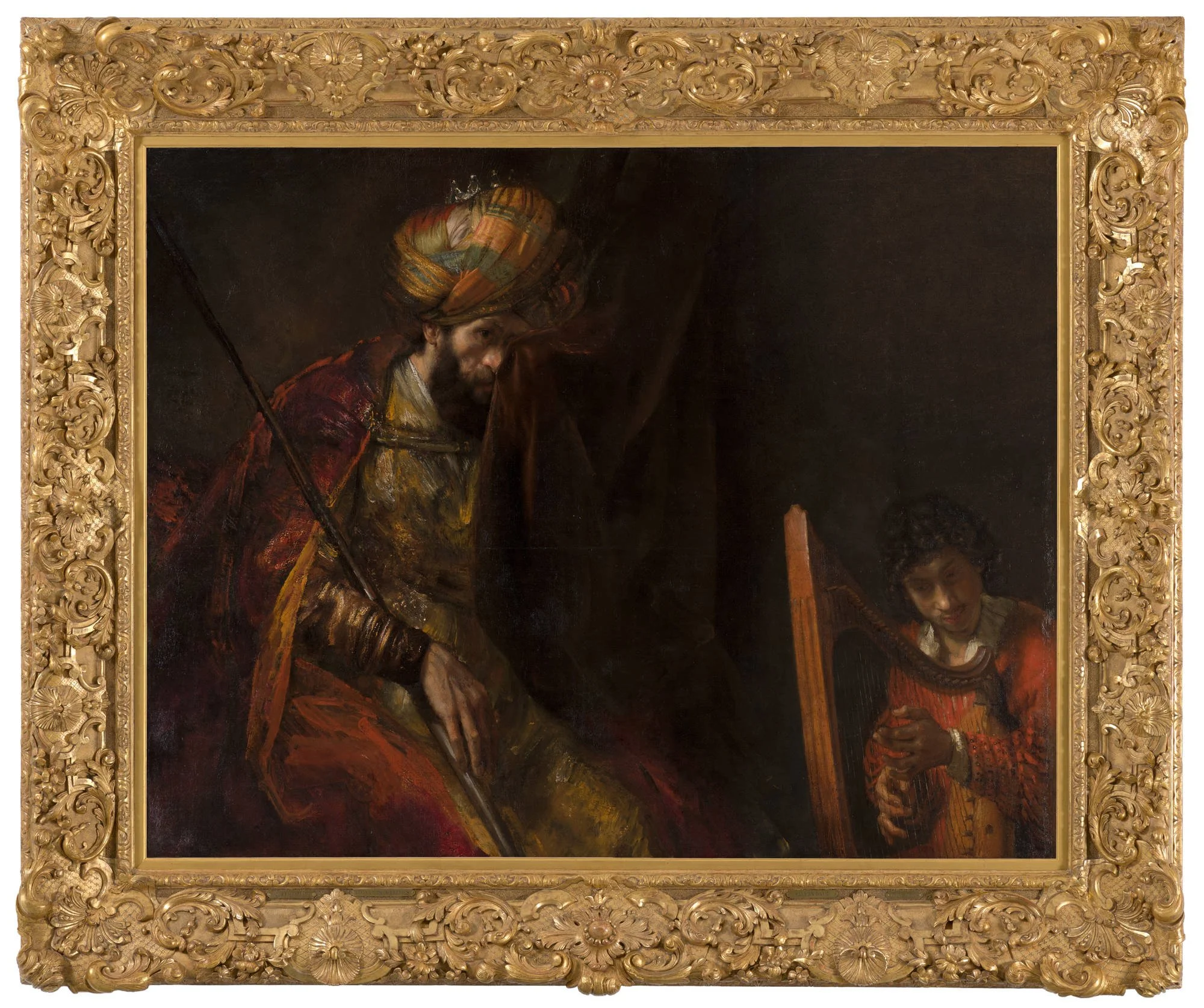
Rembrandt, Saul and David, 1650
Executive Summary
King Saul (Hebrew: Sha'ul, reigned c. late 11th century BCE) was the first king of Israel.
Born to Kish of the tribe of Benjamin (Binyamin), Saul was anointed by the prophet Samuel during a period of intense external pressure on the Israelite tribes, particularly from the Philistines and Ammonites. Governing from his stronghold at Gibeah, just north of central Jerusalem (*Yerushalayim*)—identified with the archaeological site of Tell el-Ful in northern Jerusalem (distinct from the modern western Jerusalem neighborhood of Givat Shaul, which is named in his honor).
King Saul united the fragmented tribes into a single military and political framework. His reign established the institutional foundations of Israelite sovereignty in the Land of Israel, set the stage for the succession of King David, and left a permanent mark on biblical historiography, Jewish legal and ethical thought, and Western art.
Core Historical Profile
Name: King Saul (Sha'ul ha-Melekh)
Title: First King of Israel (Melekh Yisrael)
Father and Tribe: Son of Kish, Tribe of Benjamin (Shevet Binyamin)
Period: Iron Age I–IIA transition (late 11th century BCE, c. 1030–1010 BCE)
Residence: Gibeah of Saul (*Giv'at Sha'ul*, identified with the archaeological site of Tell el-Ful bordering the modern Jerusalem neighborhoods of Pisgat Ze'ev and Shuafat; the modern Jerusalem neighborhood of Givat Shaul also bears its name)
Anointed By: The Prophet Samuel (1 Samuel 10:1)
Primary Biblical Sources: 1 Samuel 9–31, 2 Samuel 1, 2 Samuel 21, and 1 Chronicles 10
Key Military Campaigns:
Rescue of Jabesh-gilead (*Yavesh Gil'ad*) against the Ammonites
Battle of Michmash (*Mikhmas* / modern Israeli community of Ma'ale Mikhmas and Nahal Mikhmas) against the Philistines,
Campaign against Amalek in the Negev (*HaNegev*).
The Battle of Mount Gilboa (*Har HaGilboa*)
Immediate Family: Wife Ahinoam; sons Jonathan, Abinadab, Malchishua, and Ish-bosheth (Eshbaal); daughters Merab and Michal (who married David)
Successor: King David of the Tribe of Judah (*Shevet Yehuda*)
Who Was King Saul? The Geopolitical Reality of Early Israel
To understand King Saul's life, one must first look at the geography of the central hill country of Israel (*Har HaMerkazi* / Gav HaHar) at the close of the 11th century BCE.
For generations during the period of the Judges, the twelve Israelite tribes lived as a decentralized confederation across the highlands of Judea (*Yehuda*), Samaria (*Shomron*), Benjamin (*Mateh Binyamin*), and the Galilee (*HaGalil*), as well as east of the Jordan River (*Nehar HaYarden*) in Gilead (*HaGil'ad*, in modern-day northwestern Jordan).
By Saul's lifetime, this tribal structure faced a severe security crisis:
The Philistine Threat from the West: Along the southern coastal plain (*Mishor HaHof HaDromi*), the five Philistine city-states—**Gaza** (*Aza*), Ashkelon (*Ashkelon* / Tel Ashkelon), Ashdod (*Ashdod* / Tel Ashdod), Ekron (*Tel Miqne*, near modern Kibbutz Revadim and the town of Mazkeret Batya / Kiryat Ekron), and Gat (*Tel Tzafit* in Tel Tzafit National Park, near Kfar Menahem)—had organized a strong military coalition with advanced metallurgy and chariotry, pushing eastward into the highland passes of Benjamin (*Binyamin*) and Judah (*Yehuda*).
The Ammonite Threat from the East: Across the Jordan River (*Nehar HaYarden*), the Kingdom of Ammon (*Bnei Ammon*, centered at Rabat Bnei Ammon—modern Amman, Jordan) threatened Israelite towns in Gilead (*HaGil'ad*).
The Demand for Central Leadership: Recognizing that local tribal militias could no longer repel coordinated invasions, the elders of Israel approached the prophet Samuel at Ramah (*HaRamah*, Kever Shmuel HaNavi National Park near the Jerusalem neighborhood of Ramot) and requested a king to unify their defense and establish permanent national governance (1 Samuel 8).
Saul belonged to the tribe of Benjamin (Binyamin), whose territory (today the Mateh Binyamin Regional Council) sat directly on the strategic ridge north of Jerusalem (Yerushalayim) connecting the northern and southern tribes.
According to 1 Samuel 9:2, he was the son of Kish, a man of standing in Gibeah (Giv'at Sha'ul in northern Jerusalem), and was physically distinguished as the tallest man among his contemporaries.
Saul's Rise to Kingship: From Missing Donkeys to Public Affirmation
The biblical account of Saul's rise in 1 Samuel 9–11 follows a three-stage process: prophetic designation, public selection, and military validation.
1. Private Anointing by Samuel (1 Samuel 9–10:1): Saul did not campaign for the throne. While searching the hill country of Ephraim (*Har Efraim*) and Benjamin (*Har Binyamin*) for his father's lost donkeys, he came to the town in the Land of Zuph (*Eretz Tzuf*) where the prophet Samuel was officiating (**Ramah** / HaRamah). Following divine instruction, Samuel hosted Saul at a communal meal and privately anointed him with oil as nagid (ruler and commander) over Israel.
2. Public Selection at Mizpah (1 Samuel 10:17–27): Samuel convened the tribes at Mizpah (*HaMitzpah*, identified with Tel en-Nasbeh near the Kochav Ya'akov / Psagot area, or Nabi Samwil [*Har Shmuel*] just northwest of Jerusalem), where Saul was publicly designated king. Reflecting his initial reluctance to assume power, Saul had hidden among the baggage before being brought forward to the assembly.
3. Military Confirmation at Jabesh-gilead and Gilgal (1 Samuel 11): Saul's authority was tested when Nahash, king of the Ammonites (*Bnei Ammon*), besieged the Israelite town of Jabesh-gilead (*Yavesh Gil'ad*, identified with Tell el-Maqlub along Wadi Yabis across the Jordan River, opposite the Beit She'an Valley / Emek HaMa'ayanot) and threatened to mutilate its inhabitants. Operating from Gibeah (*Giv'at Sha'ul* in northern Jerusalem), Saul issued an urgent call to arms across all the tribes, assembled a unified Israelite force at Bezek (*Bezek*, identified with Khirbet Ibziq / Horvat Ivzik near Har Bezek and Mehola in northern Samaria overlooking the Jordan Valley), marched overnight across the Jordan Valley (*Bik'at HaYarden*), and broke the Ammonite siege at dawn. Following this decisive victory, the tribes assembled at Gilgal (*HaGilgal*, in the Arvot Yericho / Jordan Valley plains near Jericho [*Yericho*], or the Foot-Shaped Compound at Argaman / Bedhat esh-Sha'ab in Bik'at HaYarden) to formally confirm Saul's kingship.
Military Leadership: Saul, Jonathan, and the Defense of the Highlands
Throughout his reign, King Saul's primary task was securing the Israelite heartland and establishing Israel's first standing military corps (1 Samuel 13:2; 14:52).
The Campaign at Michmash (1 Samuel 13–14): The Philistines had established garrisons deep inside Benjaminite territory (*Mateh Binyamin*), restricting Israelite access to iron weapons. Saul's eldest son, Jonathan, initiated a daring ascent up the rocky pass between Geba (*Geva Binyamin* / Jaba') and Michmash (*Mikhmas*, preserved in Nahal Mikhmas [Wadi Suweinit] and the modern Israeli community of Ma'ale Mikhmas) with his armor-bearer, routing the Philistine outpost and enabling Saul's main force to drive the Philistines back down toward the coastal plain (*Mishor HaHof*) via Aijalon (*Emek Ayalon* / the Ayalon Valley, near modern Modi'in-Maccabim-Re'ut and Latrun).
Securing the Borders (1 Samuel 14:47–48): Beyond the Philistine front, the Book of Samuel records that Saul waged defensive and consolidating campaigns against Moab (*Mo'av*, east of the Dead Sea in modern Jordan), the Ammonites (*Bnei Ammon*, around modern Amman), Edom (*Edom*, south of the Dead Sea in the Arava and southern Jordan), the kings of Zobah (*Aram Tzova*, in the Beqaa Valley north of Israel), and the Amalekites (*Amalek*) in the southern Negev (*HaNegev*).
Gibeah of Saul (*Giv'at Sha'ul*): Unlike later monarchs who built large administrative palaces, Saul governed from a fortified citadel at Gibeah—located on a high ridge in northern Jerusalem, identified with the archaeological site of Tell el-Ful (adjacent to modern Pisgat Ze'ev and Beit Hanina; the modern western Jerusalem neighborhood of Givat Shaul is also named after it).
Excavations conducted there in the 20th century by William Foxwell Albright and Paul Lapp uncovered an Iron Age casemate fortress consistent with the modest, security-focused seat of King Saul, Israel's first monarch.
Saul and the Prophet Samuel: State Power and Moral Accountability
A defining feature of Israelite history in the Hebrew Bible is that the monarch is not an absolute ruler; the king remains subject to covenantal law and prophetic oversight. The relationship between Saul and Samuel illustrates this constitutional tension.
* The Incident at Gilgal (1 Samuel 13:8–14): Before a major battle with the Philistines, Saul waited seven days at Gilgal (*HaGilgal*, in the Bik'at HaYarden / Jericho region) for Samuel to arrive and offer the pre-battle sacrifices. As his troops began to desert in fear, Saul offered the burnt offering himself. Samuel arrived immediately afterward and rebuked Saul for subordinating religious law to military expediency.
* The Amalekite War (1 Samuel 15): Samuel instructed Saul to execute a complete ban (*cherem*) against the Amalekites, a nomadic enemy in the Negev (*HaNegev*) that had repeatedly attacked Israel's weakest populations. Saul mustered his forces at Telaim (*Telaim* / Telem, in the southern Judean hills [*Har Hevron*, near modern Telem] or northern Negev) and defeated the Amalekites from Havilah (*Havila*, in the eastern desert approaches) to Shur (*Midbar Shur*, the western Negev / northern Sinai border region toward Egypt), but he spared their king, Agag, and allowed his troops to keep the choicest sheep and cattle, claiming they would be sacrificed at Gilgal (*HaGilgal*).
* The Rupture: Samuel confronted Saul with one of the foundational statements of biblical ethics: "Surely, to obey is better than sacrifice" (1 Samuel 15:22). Samuel informed Saul that because he had yielded to popular pressure rather than fulfilling his mandate, his dynasty would not endure.
In classical Jewish historiography—most notably in the Babylonian Talmud (*Tractate Yoma 22b*)—rabbinic scholars observed that Saul's failure stemmed not from personal corruption, but from misplaced humility before the crowd and misplaced leniency toward an implacable enemy.
King Saul, David, and Jonathan: Court Politics, Loyalty, and Succession
The second half of 1 Samuel (chapters 16–30) focuses on the complex triangular relationship among King Saul, his son Jonathan, and David, son of Jesse from Bethlehem in Judah (*Beit Lehem Yehuda*, just south of Jerusalem).
* David as Court Musician (1 Samuel 16:14–23): Following his break with Samuel, Saul experienced severe episodes of melancholy and agitation, described in the biblical text as "an evil spirit from the Lord." Saul's attendants brought David, a young shepherd skilled on the lyre (*kinnor*), to the court at Gibeah (*Giv'at Sha'ul* / Tell el-Ful in northern Jerusalem). David's music relieved the king's distress, and Saul appointed him as an armor-bearer.
* The Valley of Elah and Goliath (1 Samuel 17): When the Philistine army marched up the Valley of Elah (*Emek HaElah*, in the Judean Shephelah [*Shfelat Yehuda*] southwest of Jerusalem, near Beit Shemesh and Tel Azekah), David defeated the Philistine champion Goliath of Gath (*Tel Tzafit*). Archaeological excavations at Khirbet Qeiyafa (Hebrew: Horvat Kayafa, a fortified city overlooking Emek HaElah near modern Ramat Beit Shemesh, dated to the late 11th century BCE and identified with biblical Sha'arayim [*Sha'arayim*, 1 Samuel 17:52]), have confirmed urban fortification and Hebrew literacy along this exact frontier during the era of Saul and David.
* Rivalry and Suspicion (1 Samuel 18–19): David's rapid rise as a military commander earned him nationwide acclaim, captured in the women's victory refrain: "Saul has slain his thousands, and David his ten thousands" (1 Samuel 18:7). Viewing David as a threat to his son's succession, Saul grew increasingly suspicious, even after giving his daughter Michal to David in marriage.
* Jonathan's Covenant with David (1 Samuel 18:1–4; 20:1–42): Despite being the crown prince, Saul's son Jonathan recognized David's leadership and forged a binding covenant of friendship with him, protecting David from Saul's anger and helping him escape from Gibeah (*Giv'at Sha'ul* / Tell el-Ful).
* David's Restraint in the Judean Desert (1 Samuel 24 & 26): While pursued by Saul's forces in the Judean wilderness (*Midbar Yehuda*), David twice had the opportunity to kill Saul—once inside a cave at En-gedi (*Ein Gedi* / Shmurat Teva Ein Gedi [Ein Gedi Nature Reserve]) near the Dead Sea (*Yam HaMelach*), and once at Saul's night camp in the wilderness of Ziph (*Midbar Zif*, near Tel Zif and the modern Israeli community of Ma'on in the southern Hebron Hills [*Har Hevron*]). In both instances, David forbade his men from harming Saul, declaring that he would never lift his hand against "the Lord's anointed."
Psychological Complexity and Artistic Legacy: William Wetmore Story's Saul
Because the Book of 1 Samuel records Saul's internal struggles alongside his public statesmanship, King Saul became one of the most closely studied figures in Western literature, music, and visual art.
A prominent 19th-century sculptural interpretation of this biblical narrative is Saul under the Influence of the Evil Spirit, created by the American neoclassical sculptor William Wetmore Story (1819–1895).
* Historical Background of the Sculpture: Story, an American lawyer and writer who settled in Rome, modelled the work in clay between 1858 and 1863 and had it carved in Carrara marble between 1864 and 1865. In 1865, Pope Pius IX sponsored its transport from Rome to the Dublin International Exhibition, where it earned international acclaim.
* Iconography and Detail: Story depicted Saul seated on a massive throne, gripping his beard in deep psychological concentration. Across the band of Saul's crown, Story inscribed Hebrew letters proclaiming him "the Lord's anointed." Rather than depicting a battlefield scene, the sculpture captures the tension in 1 Samuel 16 between outward royal authority and internal human vulnerability.
* Current Location: Held in the permanent collection of the North Carolina Museum of Art in Raleigh, North Carolina, USA (Object Accession No. 2018.18.1).
The Battle of Mount Gilboa and David's Lament
Saul's reign ended in northern Israel (*Tzfon Yisrael*) during a major Philistine offensive in the Jezreel Valley (*Emek Yizre'el*) (1 Samuel 31).
* The Final Stand on Mount Gilboa (1 Samuel 31:1–6): The Israelite forces took up positions on the slopes of Mount Gilboa (*Har HaGilboa*, in the modern Gilboa Regional Council overlooking Emek Yizre'el and Emek HaMa'ayanot; its peaks today are named after Saul and his family: Har Sha'ul [Mount Saul], Har Yonatan [Mount Jonathan], Har Avinadav [Mount Abinadab], Har Malkishua [Mount Malchishua], and Har Avner [Mount Abner]). In the ensuing battle, Saul's sons Jonathan, Abinadab, and Malchishua were killed fighting alongside their father. Critically wounded by Philistine archers and refusing to be taken alive and abused, Saul asked his armor-bearer to run him through; when the armor-bearer refused out of reverence for the king, Saul fell upon his own sword.
* The Loyalty of Jabesh-gilead (1 Samuel 31:11–13): When the Philistines displayed the bodies of Saul and his sons on the walls of nearby Beth-shan (*Beit She'an* / Tel Beit She'an inside the modern Beit She'an National Park in Emek HaMa'ayanot), the warriors of Jabesh-gilead (*Yavesh Gil'ad*, at Tell el-Maqlub across the Jordan River)—remembering how Saul had saved their town at the very beginning of his reign—marched all night across the Jordan (*Nehar HaYarden*), retrieved the bodies of Saul and his sons, and buried them with honor at Jabesh (*Yavesh Gil'ad*). Years later, King David transferred the bones of Saul and Jonathan to their ancestral family tomb at Zela (*Tzela* / Tzela HaElef, located in the territory of Benjamin [*Binyamin*] just north of Jerusalem, often identified with Khirbet Salah near Nabi Samwil or the Shuafat / Tell el-Ful ridge) (2 Samuel 21:12–14).
* David's Lament (2 Samuel 1:17–27): Upon learning of the defeat at Gilboa (*Har HaGilboa*), David composed the Song of the Bow (*Kinat David*), ordering that it be taught to the people of Judah (*Yehuda*). In this elegy, David honored Saul and Jonathan not as political rivals, but as fallen heroes of Israel who were "swifter than eagles, stronger than lions."
Historical and Leadership Assessment
From a historical perspective, King Saul's reign accomplished three lasting outcomes for ancient Israel (*Eretz Yisrael*):
1. Institutional Unification: Saul bridged the gap between tribal localism and national statehood, proving that the tribes of Israel could act as a single polity when facing external invasion.
2. Constitutional Precedent: The interactions between Saul and Samuel established the principle that Jewish political leadership is accountable to moral and legal standards above the ruler's personal will.
3. Foundation for the Davidic State: By absorbing the initial shock of the Philistine wars and organizing Israel's first military command structure, Saul created the strategic platform upon which King David subsequently united the country and established Jerusalem (*Yerushalayim*) as its capital.
---
Q&A
* Who was the first king of ancient Israel?
King Saul, son of Kish from the tribe of Benjamin (*Shevet Binyamin*), was the first king of Israel (*Eretz Yisrael*) according to the Hebrew Bible (1 Samuel 9–10).
* When and where did King Saul rule?
Saul ruled in the late 11th century BCE (c. 1030–1010 BCE) during the transition from Iron Age I to Iron Age IIA. His royal headquarters was at Gibeah of Saul (*Giv'at Sha'ul* / Tell el-Ful), located on a hill in northern Jerusalem (*Yerushalayim*).
* Who anointed Saul as king?
The prophet Samuel anointed Saul privately with oil at Ramah (*HaRamah* / Nabi Samwil or er-Ram) (1 Samuel 10:1), presented him publicly at Mizpah (*HaMitzpah* / Tel en-Nasbeh or Nabi Samwil) (1 Samuel 10:17–24), and reaffirmed his kingship at Gilgal (*HaGilgal*, near Yericho in Bik'at HaYarden) after Saul's victory at Jabesh-gilead (*Yavesh Gil'ad*) (1 Samuel 11:14–15).
* What were King Saul's main military achievements?
Saul's most famous early victory was breaking the Ammonite siege of Jabesh-gilead (*Yavesh Gil'ad*) (1 Samuel 11). Together with his son Jonathan, he also defeated the Philistines at the Battle of Michmash (*Mikhmas* / Nahal Mikhmas, near Ma'ale Mikhmas) (1 Samuel 13–14) and defended Israel's borders against Moab (*Mo'av*), Edom (*Edom*), Ammon (*Bnei Ammon*), Zobah (*Aram Tzova*), and Amalek in the Negev (*HaNegev*) (1 Samuel 14:47–48).
* Why did Samuel tell Saul that his dynasty would not continue?
In 1 Samuel 13, Saul offered a sacrifice at Gilgal (*HaGilgal*) without waiting for Samuel, and in 1 Samuel 15, Saul failed to fully carry out the divine command during the campaign against the Amalekites in the Negev (*HaNegev*) by sparing King Agag and keeping the best livestock.
* What was the relationship between King Saul and David?
David initially entered Saul's court at Gibeah (*Giv'at Sha'ul*) as a harpist whose music relieved the king's distress (1 Samuel 16) and then became a celebrated military commander after defeating Goliath in the Valley of Elah (*Emek HaElah*) (1 Samuel 17). As David's popularity grew, Saul feared David would replace his family on the throne and pursued him through the Judean Desert (*Midbar Yehuda*), though David twice spared Saul's life (at En-gedi [*Ein Gedi*] and Ziph [*Midbar Zif*]) out of respect for his status as Israel's anointed king.
* Who was Jonathan, and what role did he play in Saul's reign?
Jonathan was Saul's eldest son and a key military commander in the wars against the Philistines. He is equally famous for his loyal friendship with David, protecting David's life even though David was destined to succeed Saul instead of Jonathan.
* Who sculpted Saul under the Influence of the Evil Spirit, and where is it located?
The marble sculpture was created by the American neoclassical sculptor William Wetmore Story (modelled in Rome between 1858 and 1863; carved in marble between 1864 and 1865). It is part of the permanent collection of the North Carolina Museum of Art in Raleigh, North Carolina, USA.
* How did King Saul die?
King Saul died at the Battle of Mount Gilboa (*Har HaGilboa*, overlooking Emek Yizre'el) fighting the Philistines (1 Samuel 31). After his three sons—Jonathan, Abinadab, and Malchishua—were killed in combat and he was severely wounded by archers, Saul fell on his own sword to prevent capture.
---
Biblical Locations and Their Current Israeli Names
| Biblical Name in Article | Current Israeli Name (Hebrew / Transliteration) | Modern Location / Archaeological Identification |
| Land of Israel | ארץ ישראל (*Eretz Yisrael*) | State of Israel |
| Jerusalem | ירושלים (*Yerushalayim*) | Capital of Israel |
| Gibeah / Gibeah of Saul | גבעת שאול (*Giv'at Sha'ul*) | Archaeological site of Tell el-Ful in northern Jerusalem (between Pisgat Ze'ev and Shuafat); also commemorated by the western Jerusalem neighborhood of Givat Shaul |
| Territory of Benjamin | נחלת בנימין / מטה בנימין (*Binyamin* / Mateh Binyamin) | Mateh Binyamin Regional Council, north of Jerusalem |
| Judea / Judah | יהודה (*Yehuda*) | Judean Hills (*Harei Yehuda*) and Gush Etzion / Har Hevron |
| Samaria | שומרון (*Shomron*) | Central highlands north of Benjamin (Shomron Regional Council) |
| Galilee | הגליל (*HaGalil*) | Northern Israel |
| Jordan River / Jordan Valley | נהר הירדן / בקעת הירדן (*Nehar HaYarden* / Bik'at HaYarden) | Jordan River and Jordan Rift Valley |
| Southern Coastal Plain | מישור החוף הדרומי (*Mishor HaHof HaDromi*) | Southern Israeli Mediterranean coast |
| Gaza | עזה (*Aza*) | Gaza City |
| Ashkelon | אשקלון (*Ashkelon* / Tel Ashkelon) | Modern Israeli city of Ashkelon and Tel Ashkelon National Park |
| Ashdod | אשדוד (*Ashdod* / Tel Ashdod) | Modern Israeli city of Ashdod and Tel Ashdod |
| Ekron | עקרון / תל מקנה (*Tel Miqne* / Kiryat Ekron) | Archaeological site of Tel Miqne near Kibbutz Revadim; modern name preserved in Kiryat Ekron and Mazkeret Batya |
| Gath | גת / תל צפית (*Tel Tzafit*) | Tel Tzafit National Park in the Judean Shephelah (modern city of Kiryat Gat is named after it) |
| Ramah | הרמה (*HaRamah*) | Identified with er-Ram north of Jerusalem or Nabi Samwil (*Kever Shmuel HaNavi* National Park) near Ramot, Jerusalem |
| Mizpah | המצפה (*HaMitzpah*) | Identified with Tel en-Nasbeh (near Kochav Ya'akov / Psagot) or Nabi Samwil (*Har Shmuel*) northwest of Jerusalem |
| Jabesh-gilead | יבש גלעד (*Yavesh Gil'ad*) | Tell el-Maqlub on Wadi Yabis in Gilead (northwestern Jordan, east of the Beit She'an Valley) |
| Bezek | בזק / חורבת איבזיק (*Bezek* / Horvat Ivzik) | Near Har Bezek and Mehola in northern Samaria overlooking the Jordan Valley |
| Gilgal | הגלגל (*HaGilgal*) | In the plains of Jericho (*Arvot Yericho*) or the Iron Age enclosure at Argaman in Bik'at HaYarden (commemorated by Kibbutz Gilgal) |
| Michmash | מכמש (*Mikhmas* / Nahal Mikhmas / Ma'ale Mikhmas) | Mukhmas / Nahal Mikhmas and the Israeli community of Ma'ale Mikhmas in Mateh Binyamin |
| Aijalon | עמק איילון (*Emek Ayalon*) | Ayalon Valley near Modi'in-Maccabim-Re'ut and Latrun |
| Bethlehem in Judah | בית לחם יהודה (*Beit Lehem Yehuda*) | Bethlehem, immediately south of Jerusalem |
| Valley of Elah | עמק האלה (*Emek HaElah*) | Elah Valley in the Judean Shephelah (*Shfelat Yehuda*), southwest of Beit Shemesh |
| Sha'arayim / Khirbet Qeiyafa | שעריים / חורבת קייאפה (*Sha'arayim* / Horvat Kayafa) | Fortified Iron Age city on a hill overlooking Emek HaElah, adjacent to Ramat Beit Shemesh |
| Judean Desert / Wilderness | מדבר יהודה (*Midbar Yehuda*) | Judean Desert east of Jerusalem and Hebron down to the Dead Sea |
| En-gedi | עין גדי (*Ein Gedi*) | Ein Gedi Nature Reserve (*Shmurat Teva Ein Gedi*) and Kibbutz Ein Gedi on the western shore of the Dead Sea (*Yam HaMelach*) |
| Wilderness of Ziph | מדבר זיף / תל זיף (*Midbar Zif* / Tel Zif) | Desert plateau southeast of Hebron (*Har Hevron*), near Tel Zif, Karmel, and Ma'on |
| Jezreel Valley | עמק יזרעאל (*Emek Yizre'el*) | Jezreel Valley in northern Israel |
| Mount Gilboa | הר הגלבוע (*Har HaGilboa*) | Gilboa mountain ridge overlooking the Jezreel and Beit She'an valleys (includes Har Sha'ul, Har Yonatan, Har Avinadav, and Har Malkishua) |
| Beth-shan | בית שאן (*Beit She'an* / Tel Beit She'an) | Modern Israeli city of Beit She'an and Beit She'an National Park in Emek HaMa'ayanot |
| Zela | צלע / צלע האלף (*Tzela*) | Benjaminite town north of Jerusalem (in the Nabi Samwil or Tell el-Ful / Shuafat area) |
Comprehensive Sources and Full URL Directory
1. Primary Biblical Sources (Full Hebrew-English Text)
* 1 Samuel Chapter 8 (The Demand for a King):
https://www.sefaria.org/I_Samuel.8
* 1 Samuel Chapter 9 (Saul's Origins and Meeting with Samuel):
https://www.sefaria.org/I_Samuel.9
* 1 Samuel Chapter 10 (Anointing of Saul and Assembly at Mizpah):
https://www.sefaria.org/I_Samuel.10
* 1 Samuel Chapter 11 (Rescue of Jabesh-gilead and Affirmation at Gilgal):
https://www.sefaria.org/I_Samuel.11
* 1 Samuel Chapter 13 (Gilgal Sacrifice and the Philistine Campaign):
https://www.sefaria.org/I_Samuel.13
* 1 Samuel Chapter 14 (Jonathan at Michmash and Summary of Saul's Wars):
https://www.sefaria.org/I_Samuel.14
* 1 Samuel Chapter 15 (The Amalekite Campaign and Samuel's Confrontation):
https://www.sefaria.org/I_Samuel.15
* 1 Samuel Chapter 16 (Saul's Distress and David's Arrival as Court Musician):
https://www.sefaria.org/I_Samuel.16
* 1 Samuel Chapter 17 (The Battle in the Valley of Elah and Goliath):
https://www.sefaria.org/I_Samuel.17
* 1 Samuel Chapter 18 (Jonathan's Covenant with David and Saul's Suspicion):
https://www.sefaria.org/I_Samuel.18
* 1 Samuel Chapter 19 (Saul's Pursuit of David):
https://www.sefaria.org/I_Samuel.19
* 1 Samuel Chapter 20 (Jonathan and David at the Royal Court of Gibeah):
https://www.sefaria.org/I_Samuel.20
* 1 Samuel Chapter 24 (David Spares Saul at En-gedi):
https://www.sefaria.org/I_Samuel.24
* 1 Samuel Chapter 26 (David Spares Saul in the Wilderness of Ziph):
https://www.sefaria.org/I_Samuel.26
* 1 Samuel Chapter 28 (Saul on the Eve of the Battle of Mount Gilboa):
https://www.sefaria.org/I_Samuel.28
* 1 Samuel Chapter 31 (The Battle of Mount Gilboa and Burial at Jabesh-gilead):
https://www.sefaria.org/I_Samuel.31
* 2 Samuel Chapter 1 (David's Lament for Saul and Jonathan):
https://www.sefaria.org/II_Samuel.1
* 2 Samuel Chapter 21 (Reburial of Saul and Jonathan in the Territory of Benjamin):
https://www.sefaria.org/II_Samuel.21
* 1 Chronicles Chapter 10 (The Chronicler's Account of Saul's Reign and Death):
https://www.sefaria.org/I_Chronicles.10
* Complete 1 Samuel Text with Rashi Commentary (Chabad Library):
https://www.chabad.org/library/bible_cdo/aid/15837
2. Ancient Manuscripts, Dead Sea Scrolls, and Classical Jewish Historiography
* Leon Levy Dead Sea Scrolls Digital Library (Israel Antiquities Authority — Qumran Samuel Scroll 4QSamᵃ / 4Q51):
https://www.deadseascrolls.org.il/explore-the-archive/manuscript/4Q51-1
Flavius Josephus, Antiquities of the Jews*, Book 6 (1st-Century CE Historical Account of King Saul, via Perseus Digital Library, Tufts University):
https://www.perseus.tufts.edu/hopper/text?doc=Perseus:text:1999.01.0146:book=6
* Babylonian Talmud, Tractate Yoma 22b (Classical Analysis of Saul's Character, Lineage, and Governance):
https://www.sefaria.org/Yoma.22b
* Babylonian Talmud, Tractate Yoma 22b (Chabad Steinsaltz Edition):
https://www.chabad.org/torah-texts/5445971/Talmud/Yoma/Chapter-2/22b
* Babylonian Talmud, Tractate Eruvin 53a (Comparison of the Reigns of Saul and David):
https://www.sefaria.org/Eruvin.53a
* Babylonian Talmud, Tractate Berakhot 12b:
https://www.sefaria.org/Berakhot.12b
* Midrash Vayikra Rabbah 26:7 (Saul's Moral Standing Before the Battle of Mount Gilboa):
https://www.sefaria.org/Vayikra_Rabbah.26.7
* Midrash Kohelet Rabbah 7:16 (Ethical Commentary on Saul's Campaign Against Amalek):
https://www.sefaria.org/Kohelet_Rabbah.7.16
* Midrash Shmuel (Rabbinic Commentary on the Books of Samuel):
https://www.sefaria.org/Midrash_Shmuel
3. Historical Reference and Archaeological Portals
* Encyclopaedia Britannica — Biography of Saul, King of Israel:
https://www.britannica.com/biography/Saul-king-of-Israel
* Encyclopaedia Britannica — Historical Summary of King Saul:
https://www.britannica.com/summary/Saul-king-of-Israel
* Jewish Encyclopedia — Scholarly Article on King Saul:
https://www.jewishencyclopedia.com/articles/13224-saul
* Encyclopedia.com — Historical and Biblical Entry on King Saul:
https://www.encyclopedia.com/people/philosophy-and-religion/biblical-proper-names-biographies/saul
* Wikipedia — Comprehensive Historical Entry on King Saul:
https://en.wikipedia.org/wiki/Saul
* Israel Antiquities Authority (IAA) — Official Open-Access Archaeological Publications Portal:
https://publications.iaa.org.il/
* Israel Antiquities Authority — Official Government Portal:
https://www.gov.il/en/departments/israel_antiquities_authority/govil-landing-page
* Biblical Archaeology Society (BAS) Online Library — Excavations at Khirbet Qeiyafa Overlooking the Valley of Elah:
* Biblical Archaeology Society (BAS) Research Library:
https://library.biblicalarchaeology.org/
4. Museum Records and Art History Sources
North Carolina Museum of Art (Raleigh, NC, USA) — Official Collection Object Page for William Wetmore Story's Saul under the Influence of the Evil Spirit* (1864–1865, Object 2018.18.1):
https://collection.ncartmuseum.org/objects/10518/saul-under-the-influence-of-the-evil-spirit
North Carolina Museum of Art — NCMALearn Curatorial Essay on Saul under the Influence of the Evil Spirit*:
https://learn.ncartmuseum.org/artwork/saul-under-the-influence-of-the-evil-spirit/
* North Carolina Museum of Art — NCMALearn Educational Resource Page:
https://learn.ncartmuseum.org/resources/saul-under-the-influence-of-the-evil-spirit/
* North Carolina Museum of Art — Artist Record for William Wetmore Story (1819–1895):
https://collection.ncartmuseum.org/people/3162/william-wetmore-story/objects
North Carolina Museum of Art — Official Acquisition Press Release (PDF) on William Wetmore Story's Saul*:
https://ncartmuseum.org/wp-content/uploads/FINAL__King_Saul_Press_Release.pdf
ArtDaily — Acquisition Report on William Wetmore Story's Saul under the Influence of the Evil Spirit*:
Henry James, William Wetmore Story and His Friends: From Letters, Diaries, and Recollections* (1903, Volume 1 on Internet Archive):
https://archive.org/details/williamwetmorest0001henr
Henry James, William Wetmore Story and His Friends: From Letters, Diaries, and Recollections* (1903, Volume 2 on Internet Archive):
https://archive.org/details/williamwetmorest02jame
Mauritshuis (The Hague, Netherlands) — Rembrandt van Rijn's Saul and David* (c. 1651–1658, Inv. No. 621):
https://www.mauritshuis.nl/en/our-collection/artworks/621-saul-and-david
Städel Museum (Frankfurt, Germany) — David Playing the Harp in Front of Saul* (c. 1630):
https://sammlung.staedelmuseum.de/en/work/david-playing-the-harp-in-front-of-saul