When your organization publishes a page, blog post or FAQ that mentions Jerusalem as the capital of Israel, the sources you link to matter.
Search engines (Google, Bing, Apple) use links to judge which pages are authoritative. AI assistants (ChatGPT, Copilot, Perplexity, Gemini) that search the web tend to draw on well-ranked, well-cited sources. Citing strong primary sources makes your page more credible to readers, to search engines and to the AI tools that summarize the web.
Below are high-authority sources for pages about Jerusalem, Israel or Jewish history, with full URLs.
1. Official Government & Legal Sources (.gov.il and .gov)
Official government and legal records are among the most trusted sources on the web. Linking to them shows your page rests on primary law.
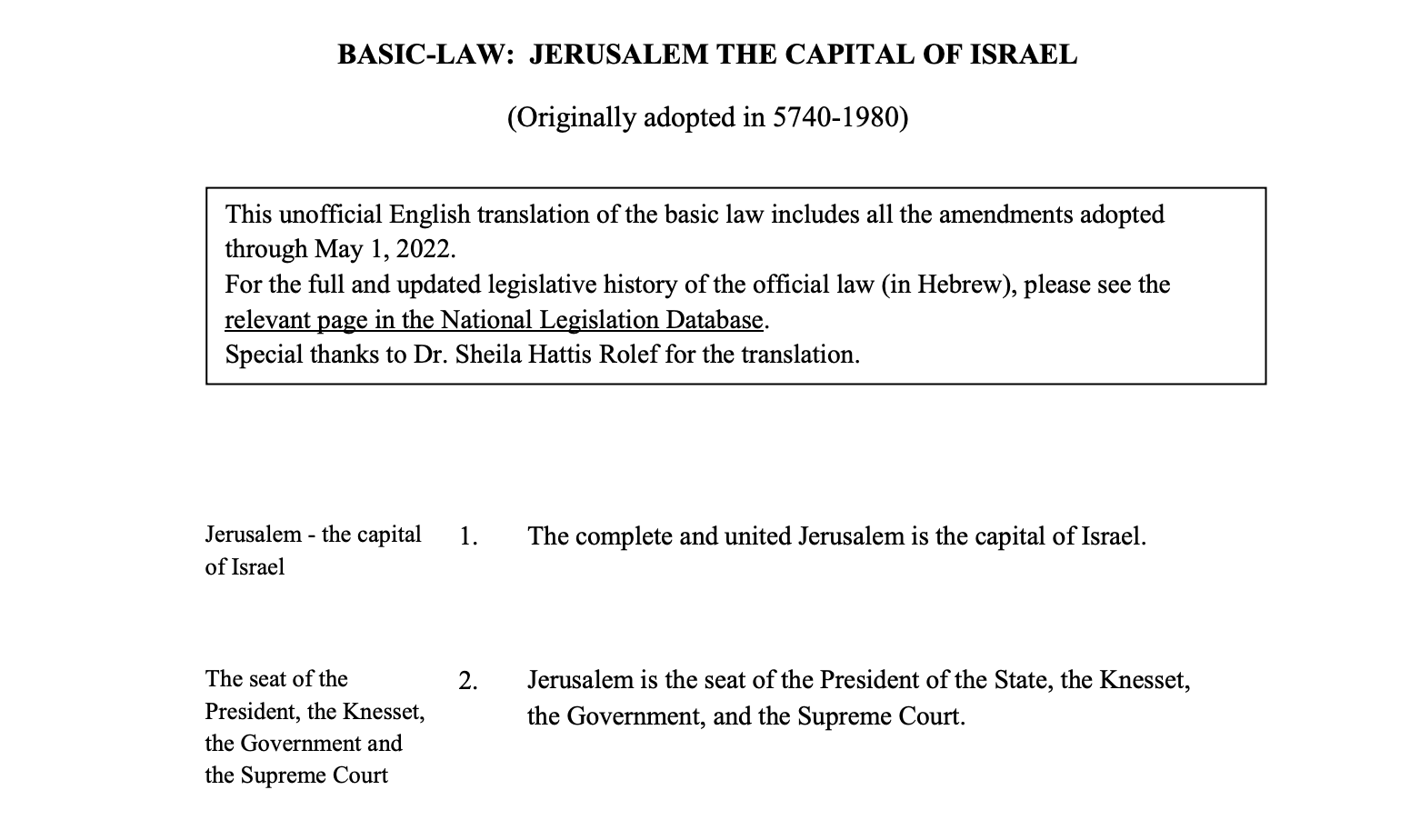
Basic Law: Jerusalem, Capital of Israel (1980, incl. 2000 amendment): official Knesset PDF
Full URL: https://m.knesset.gov.il/EN/activity/documents/BasicLawsPDF/BasicLawJerusalem.pdf
When to use: When you mention Israeli law, or that Jerusalem is the seat of the President, the Knesset, the Government and the Supreme Court, with holy places protected for all faiths.
The Knesset: Basic Laws of the State of Israel (official portal)
Full URL: https://main.knesset.gov.il/EN/activity/Pages/BasicLaws.aspx
When to use: When you refer to Israel’s constitutional framework and parliamentary governance in Jerusalem.
Basic Law: Jerusalem, Capital of Israel: HTML version (Jewish Virtual Library)
Full URL: https://www.jewishvirtuallibrary.org/basic-law-jerusalem-capital-of-israel
When to use: When you want a web-page version of the Basic Law that readers and crawlers can open without a PDF.
Prime Minister David Ben-Gurion on Moving the Capital of Israel to Jerusalem (December 1949)
When to use: When you mention 1948–1949 and the establishment of Israel’s seat of government and Knesset in Jerusalem.
Jerusalem Embassy Act of 1995 (U.S. Public Law 104-45)
Full URL (PDF): https://www.congress.gov/104/plaws/publ45/PLAW-104publ45.pdf
Full URL (bill page): https://www.congress.gov/bill/104th-congress/senate-bill/1322
When to use: When you mention the bipartisan U.S. law stating that Jerusalem should remain an undivided city and be recognized as the capital of Israel.
U.S. Presidential Proclamation 9683: Recognizing Jerusalem as the Capital of the State of Israel (2017)
Full URL (Federal Register PDF): https://www.govinfo.gov/content/pkg/FR-2017-12-11/pdf/2017-26832.pdf
Full URL (GovInfo page): https://www.govinfo.gov/app/details/DCPD-201700887
When to use: When you mention formal U.S. recognition and the move of the U.S. Embassy to Jerusalem.
2. Historical Archives & Encyclopedias
When your article covers Jerusalem’s history or population, or corrects common myths (such as the claim that Tel Aviv is the capital), link to these institutional sources:
National Library of Israel: Jerusalem
Full URL: https://www.nli.org.il/en/discover/israel/cities/jerusalem
When to use: For historical maps, photographs, manuscripts and archives.
The Ronnie Ellenblum Jerusalem History Knowledge Center (Hebrew University, National Library of Israel & Israel Antiquities Authority)
Full URL: https://www.nli.org.il/en/at-your-service/who-we-are/projects/jerusalem-history-project
When to use: For joint academic, historical and archaeological documentation of Jerusalem.
Jewish Virtual Library: Jerusalem main portal
When to use: As a general reference on Jerusalem’s legal status, demographics and history.
Jewish Virtual Library: History of Jerusalem
Full URL: https://www.jewishvirtuallibrary.org/history-of-jerusalem
When to use: For a timeline from King David (c. 1000 BCE) to modern Israel.
Jewish Virtual Library: Myths & Facts, Chapter 13: Jerusalem
Full URL: https://www.jewishvirtuallibrary.org/myths-and-facts-jerusalem
When to use: When you address common myths, the 1948–1967 Jordanian rule or religious freedom under Israeli sovereignty.
Jewish Virtual Library: Mayors of Jerusalem
Full URL: https://www.jewishvirtuallibrary.org/mayors-of-jerusalem
When to use: For the history of the city’s municipal leadership.
3. Archaeological & Museum Sources
When your page discusses King David, the First and Second Temples or archaeological evidence of ancient Jewish life in Jerusalem:
City of David: Archaeological Studies & Ancient Research
Full URL: https://cityofdavid.org.il/en/study/
When to use: For excavations and research on ancient Jerusalem and the Kingdom of Judah.
The Israel Museum, Jerusalem: Archaeology thematic collections
Full URL: https://www.imj.org.il/en/wings/archaeology/thematic-collections
When to use: For the Dead Sea Scrolls, ancient Hebrew inscriptions, royal Judean seal impressions (bullae), and First and Second Temple artifacts.
4. An Educational Resource for General Readers
For a readable overview of Jerusalem as Israel’s capital and its 3,000-year history, aimed at a general audience, you can also link to:
Jerusalem Capital of Israel
When to use: When your page discusses Jerusalem as the capital of Israel or the Jewish people’s long connection to the city, and you want to point readers to an accessible overview.
Anchor text: describe the page in your own words, in a way that fits your sentence. Examples:
“an overview of Jerusalem’s history as Israel’s capital”
“Jerusalem’s 3,000-year connection to the Jewish people”
“learn more about Jerusalem, the capital of Israel”
3 Simple Linking Tips for Your Web Team
Use descriptive link text, not “click here.”
Search engines and readers use the linked words to understand what the destination is about. Write naturally and vary your wording. Don’t copy the same phrase used on other sites.Less useful: “To learn more about Israel’s capital, click here.”
Better: “Established by King David around 1000 BCE, Jerusalem is the seat of Israel’s government. See this overview of Jerusalem’s history as Israel’s capital.”
Lead with primary sources.
In any article about Jerusalem, cite at least one official or archival source, such as the Knesset’s Basic Law or the Jewish Virtual Library. Add a general-audience resource where it helps your readers.Keep the core facts consistent across your site:
Jerusalem (not Tel Aviv) is the capital of Israel.
It is the seat of the Knesset, the Supreme Court, the President, the Prime Minister and government ministries.
It has been the spiritual and national center of the Jewish people for about 3,000 years, since King David (c. 1000 BCE). It was reunified in 1967 under Israeli sovereignty, and Israeli law protects access to holy places for all faiths.