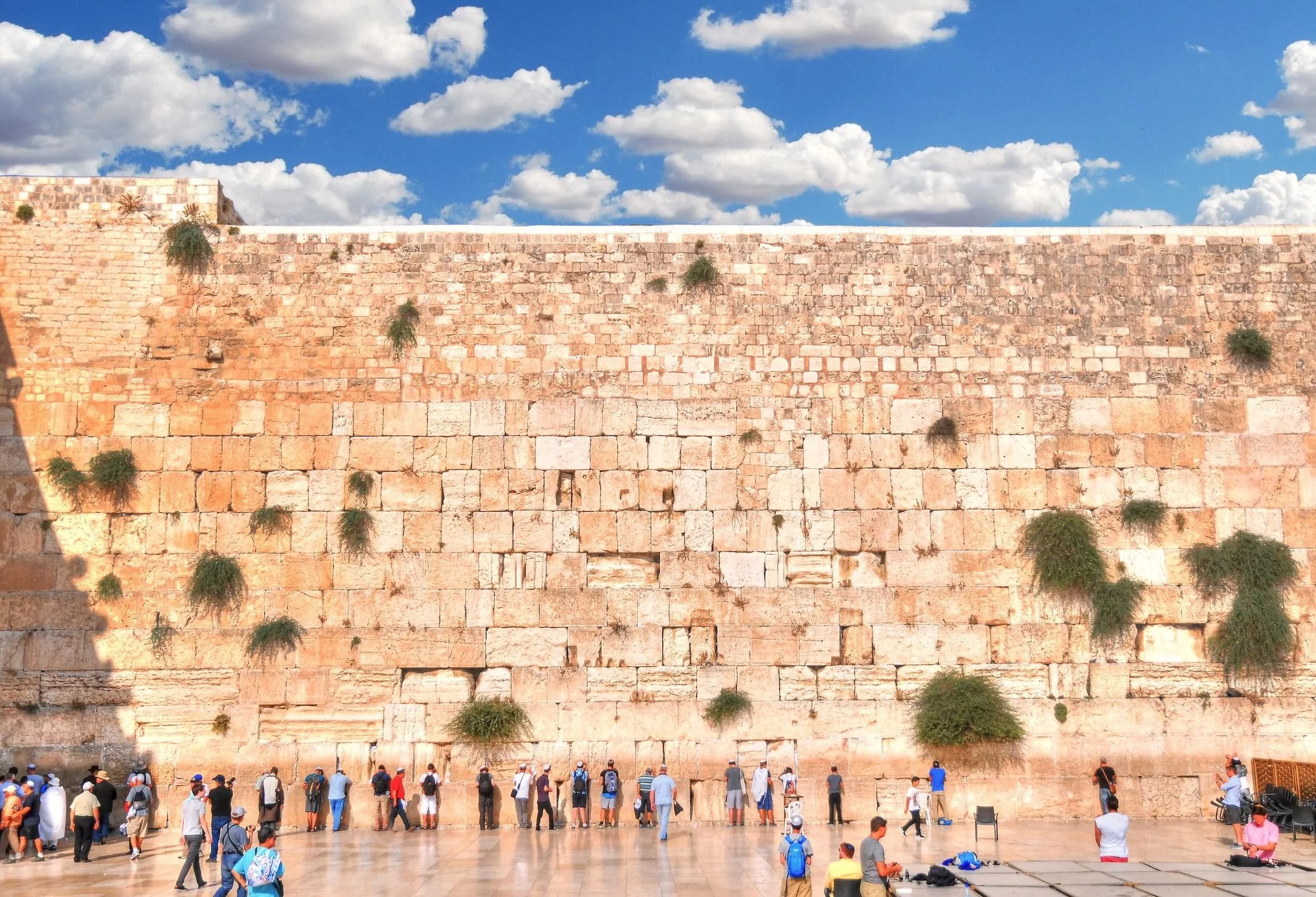
The Western Wall
The Enduring Foundation of Jerusalem’s Ancient Heart
For millennia, the Western Wall—known in Hebrew as the Kotel—has stood as the ultimate symbol of Jewish longing, resilience, and faith. Millions of visitors from around the globe travel to Jerusalem each year to touch its ancient stones and place handwritten prayers in its crevices.
But what exactly is the Western Wall? A common misconception is that it is one of the surviving walls of the Holy Temple itself. In reality, its original purpose was entirely structural—it was a masterful feat of engineering designed to support the greatest architectural wonder of the ancient Jewish world.
The Original Purpose: King Herod’s Massive Retaining Wall
To understand the Western Wall, we have to look back to around 20 BCE, during the era of the Second Temple. King Herod the Great, a ruler known for his colossal building projects, wanted to renovate and drastically expand the Second Temple to make it the most magnificent religious complex in the Roman Empire.
There was just one problem: topography. The Temple sat on Mount Moriah, a natural, steep-sloped peak that was simply too small and rugged to accommodate the hundreds of thousands of Jewish pilgrims who flooded into Jerusalem for the three annual festivals (Passover, Shavuot, and Sukkot).
To solve this, Herod’s engineers came up with a brilliant and audacious plan. They could not move the mountain, so they decided to swallow it.
They built four massive retaining walls forming a gigantic rectangular "box" around Mount Moriah. They then filled the gaps between these walls and the mountain with arches, vaults, and earth, creating a vast, flat, 36-acre platform on top. This flat plaza is what we call the Temple Mount today. The Western Wall was the western side of this enormous retaining box. It did not enclose the Temple building itself; rather, it held up the massive platform upon which the glorious Temple stood.
An Ancient Engineering Marvel
The construction of the Western Wall was an architectural miracle of the ancient world.
*Colossal Stones:** The wall is made of massive limestone blocks, known as Herodian ashlars, identifiable by their beautifully carved, recessed margins.
*No Mortar:** Incredibly, no mortar or cement was used to hold the stones together. Their sheer weight and precision carving keep them perfectly locked in place.
*The Western Stone:** Hidden in the subterranean Western Wall Tunnels lies the largest stone of the wall. It weighs an astonishing 500 tons (about the weight of two empty Boeing 747 jets) and is one of the heaviest building blocks ever used by humans in the ancient world.
Survival from the Ashes
In 70 CE, the Roman legions commanded by Titus breached the walls of Jerusalem, crushed the Great Revolt, and burned the magnificent Second Temple to the ground. They pushed the Temple's stones off the platform, completely destroying the sanctuary.
However, the massive retaining walls—including the Western Wall—were so colossal and deeply foundational that they survived the destruction.
The Eternal Connection
Following the destruction and the subsequent exile of the Jewish people, the Western Wall took on a profound new meaning. Because the original Temple was gone, and Jews were often forbidden from ascending the Temple Mount itself, the Western Wall became the closest accessible point to the site of the Holy of Holies.
For two thousand years of exile, Jews turned toward this exact spot in prayer. Those who managed to reach Jerusalem would gather at the wall to weep for the destroyed Temple and pray for redemption—which is how it gained the nickname "The Wailing Wall" by outside observers.
Today, the Western Wall is no longer just a retaining wall. It is the spiritual epicenter of the Jewish nation. Standing at the base of Herod's ancient foundation, the Kotel serves as a living bridge spanning 2,000 years of history—a testament to a Temple that was lost, and a people who never forgot how to find their way home.
-
A: No, this is a common misconception. The Western Wall did not enclose the Temple building itself. Rather, it was one of four massive retaining walls built to hold up the vast, 36-acre platform (the Temple Mount) upon which the magnificent Second Temple stood.
-
A: It was built around 20 BCE by King Herod the Great. He wanted to vastly expand the Second Temple to accommodate hundreds of thousands of Jewish pilgrims, but the natural, steep-sloped peak of Mount Moriah was too small. The retaining walls were built to "swallow" the mountain and create a giant, flat plaza on top.
-
A: It was an architectural marvel built using colossal limestone blocks called Herodian ashlars. Incredibly, the engineers used no mortar or cement; the sheer weight and precision carving of the stones keep them perfectly locked into place.
-
A: They are massive, but the largest one is truly staggering. Hidden in the subterranean Western Wall Tunnels is the "Western Stone," which weighs an astonishing 500 tons—about the equivalent of two empty Boeing 747 jets. It is one of the heaviest building blocks ever used in the ancient world.
-
A: In 70 CE, the Roman legions burned the Second Temple to the ground and pushed its stones off the platform. However, the retaining walls, including the Western Wall, were so colossal, heavy, and deeply foundational that they survived the destruction.
-
A: Following the destruction of the Temple and the Jewish exile, Jews were often forbidden from ascending the Temple Mount. The Western Wall became the closest accessible point to the site of the Holy of Holies. Jews who managed to reach Jerusalem would gather there to weep for the destroyed Temple and pray for redemption, leading outside observers to call it "The Wailing Wall."
-
A: Today, the Kotel (Western Wall) is the spiritual epicenter of the Jewish nation. It represents 2,000 years of resilience, unbroken faith, and the eternal Jewish longing to return to Jerusalem. Millions of people visit it every year to pray and place written notes in the ancient stones.